Monday, September 18, 2006

Muslim Outrage Over Pope's Statement

I wouldn't even have known about this had not the other day an Atheist Richard Dawkins comment asking for my feedback on what the pope said which has the Muslims infuriated. After reading the offensive excerpt I really found that I agree with what was said by the pope (even though I am strongly protestant), Islam is without question an extremely violent religion it was founded upon violence and in its holy books it positively preaches violence particularly against the Jewish people (For a good write up on the pope's comments check out What James White at Alpha and Omega wrote). Now I was commenting to my wife about this situation and how many were calling for the pope to apologize for his "offensive statement", and I said you know why they are calling for the pope to apologize right? It's because the Muslims are going to get violent (and only validate the pope's charge)." Sadly, what I said has already come to pass, a nun was killed in retaliation to the pope's statements about Islam's violence for a BBC article on her death click here. I found out about this through Centurion's blog, I don't want to note this woman's death as a mere "Yep that's what I said was gonna happen..." but rather to just ask: what would be a responsible way of handling the rising problem of Islamic violence not only as western citizens but as Christians? I really don't have any answers.

The ABC news reports:
"In Iran, supreme leader Ayatollah Ali Khamenei used the comments to call for protests against the United States. He argued that while the pope may have been deceived into making his remarks, the words give the West an "excuse for suppressing Muslims" by depicting them as terrorists.
[Now note the double speak as he goes on to say...]
"Those who benefit from the pope's comments and drive their own arrogant policies should be targeted with attacks and protests," he said, referring to the United States."

When I read statements like this one thing is clear, we are not dealing with rational people who are sincerely interested in peace, that's just the PC talk guys like Ayatola have adopted. So how do we as westerners react to this growing situation?

Tuesday, September 12, 2006

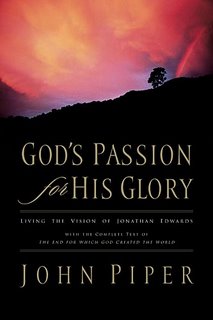
God's Passion For His Glory: (Treasuring Sola Deo Gloria)

Piper's Wonderful Book on the God centeredness of GodI end the posts on the five solas with the one that has in recent years been the most revolutionary, and precious to me, Sola Deo Gloria. To be brief we live in a consumeristic culture and this mindset really is an integral part of our thinking. We analyze products with the mindset of how they will make us feel and what benefit they will bestow upon us in contrast with the cost (Time, money etc). Our philosophical views as well as theological will contain elements of this cultural influence. In the area of theology it is clearly seen in the most popular books over the past decade in the Christian market:
"Your Best Life Now, 7 Steps to Living At Your Full Potential"
"40 Days to Purpose"
"Discovering Your Destiny"
"The Prayer of Jabez: Breaking Through To the Blessed Life" etc.

Do we see a trend here? There are products being sold to consumers in each of these titles, purpose, the best life possible, power unleashed, destiny. This is natural and to be expected in a consumeristic culture, and I would argue that the consumer culture is not the root of our man-centeredness but a fruit. Our man-centeredness is ultimately birthed from the fall in Eden where Adam our federal head chose autonomy rather than submission to God.

To cut to the chase we as 21st century evangelicals have adopted a thinking about God which elevates man and his will over God, man will be his own predestinator, man will be reached on his terms, and man will worship God as seems right in his own eyes (now I am not just talking about Arminianism for that is only a part of the picture, albeit a big part). We really think God's reason for existence is to serve and comfort us, He is a sort of Grandpa in the sky who gives us a boost (purpose, good life) and is there when we want and to be met how we want.

This is in stark contrast to the vision of God in the Bible, a God who is jealous for His name, and does all things for His own glory. It has been this truth that has shaped my vision of God as no other doctrine, I think this is the very center of all other doctrines. Sola Deo Gloria is like a gushing mountain spring from which flow numerous streams of truth (justification, redemption, election, the incarnation etc) all finding their fount and source in the truth that God does all things for the sake of His glory. In the following post I will lean heavily on Jonathan Edwards' Treatise: "The End For Which God Created the World, it has been Edwards' book that has pointed me to this truth that has shaped everything I do.

The first half of this will be philosophical, and here I will lean most heavily on Edwards, the second will be a scriptural testimony of this truth, this is how Edwards divides his book. In the second half will be scripture after scripture that supports this thesis so if you aren't into philosophical treatise just skip down to the second half.

I) The Chief End of God...(Philo)

Firstly, a distinction needs to be made between "ultimate" ends and "subordinate" ends. Edwards writes: "A subordinate end is what an agent aims at, not at all upon its own account, but wholly on the account of a further end of which it is considered as a means."(1)

The point here is that there are acts done by any agent really that are not the end in themselves but carried out to accomplish an end. An example would be going to work, going to work is not an end in itself (generally) but a means to an end such as providing for one's family. Thus the ultimate end is that which is sought for its own sake, what is valued of its own account and not in itself a means to another end. Based upon this Edwards maps out the following line of thought:

a.) "A subordinate end is never valued (as a chief end) above its own ultimate end."(2) Based upon the above definition of subordinate and ultimate ends it is absurd to say that the means is more valued than the end itself.
b) "When there is only one ultimate end it is chief above all other ends."(3) If there be any one ultimate end every other end is only a means to that ultimate end. This is so in the operations of God.
c) "The 'original' and ultimate end of all creation governs all of God's works"(4)

d) "In the 'highest sense' of God's ultimate end in creation, this end is also the end of all His works of providence."(5) What Edwards is saying here is that the end for which God created the world is the same end aimed at by God in all His works in interacting with mankind throughout history.
e) "There is only one ultimate end of creation if only one end is agreeable in itself"(6) If there is one sole reason by itself as to the motive of God in creation then that same motive (end) is what is aimed at in all of God's works.

This is a logical argument and I have left out some of the scrupulous steps for spaces sake but the point we arrive at is e) that if there is but one end which motivated God to create that same end is what is aimed at in all His works, and is most prized by God. Now Edwards moves to defining what original end for which God created the world is.

"Whatever that be which is in itself most valuable, and was so originally, prior to the creation of the world, and which is attainable by creation, if there be any thing which was superior in value to all others, that must be God's last end in the creation; and also worthy to be his highest end." (7)

"And, Therefore, if God has respect to things according to their nature and proportions, He must necessarily have the greatest respect to Himself."(8) What has been said in these last statements is that if God is values things appropriately the most valuable must be God Himself. This must be so for God to be upright, for God to be upright is for Him to value that which is most good (Himself).
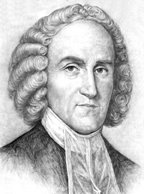
Jonathan Edwards, the greatest theologian American soil has produced.
"Hence it will follow that the moral rectitude of the disposition, inclination, or affection of God CHIEFLY consists in regard to HIMSELF, infinitely above His regard to all other beings; in other words, His holiness consists in this."(9)

This statement is extremely profound, Edwards is arguing that God's holiness demands that God value that which is most valuable, namely HIMSELF, for God to do otherwise would be to compromise His holiness. God would be unrighteous in fact if he failed to delight fully in what is most beautiful, and worthy , namely Himself. So how do we as creatures fit into this picture? To quote Edwards:

"If the perfection itself be excellent, the knowledge of it is excellent and the esteem of it is excellent. And as it is fit that God should love and esteem His own excellence, it is also fit that He should value and esteem the love of his excellency. And if it becomes a being to highly value Himself, it is fit that He should love to have Himself valued and esteemed."(10)

This is amazing, if Edwards is right the popular bookstore view of God that is so often presented (having man chief in His affections) is way off the mark. Yet through philosophic reasoning we are begining to see the God-centeredness of God, howeverm ultimately scripture is where we must turn to see what is chief in God's affections.

II) The Chief End of God... (Scripture)

From the arguments above the conclusion is reached that God has His own glory chief in His affections, this is the end sought in all that He does. We now turn to the bible because ultimately this is where this truth shines most brightly, through creation, providence and redemption. I will just put up the passages and comment here and there the point should become fairly evident that God in His acting has His glory (Himself) chiefly in mind.

First and Last:
"Thus says the LORD, the King of Israel and his Redeemer, the LORD of hosts: "I am the first and I am the last; besides me there is no god." (Isa 44:6)

"Listen to me, O Jacob, and Israel, whom I called! I am he; I am the first, and I am the last." (Isa 48:12)

"I am the Alpha and the Omega," says the Lord God, " (Rev 1:8)

"And he said to me, "It is done! I am the Alpha and the Omega, the beginning and the end. To the thirsty I will give from the spring of the water of life without payment." (Rev 21:6)

The point here is that God is the first and the last, He authored creation and He is the end to which creation moves. This is how the Lord's prayer ends as well.

The Duty of Man: Scripture settles this firmly
"So, whether you eat or drink, or whatever you do, do all to the glory of God." (1 Cor 10:31)

"whoever speaks, as one who speaks oracles of God; whoever serves, as one who serves by the strength that God supplies--in order that in everything God may be glorified through Jesus Christ. To him belong glory and dominion forever and ever. Amen." (1 Per 4:11)

Here we see man is to seek the glory of God above all, and ascribe glory to God. Many more scriptures can be cited but I wish to focus on the issues of redemption.

Christ's Ultimate End In His Ministry:
It would probably be casually stated by most believers that the ultimate end of Christ's ministry on earth was the redemption of men. However, if Edwards is right and I understand the bible correctly, the salvation of sinners is not an ultimate end but rather a "subordinant". The ultimate aim in Christ's work was the glory of God. Thus, it is because God is passionate about His glory that sinners have hope, God will be glorified through saving and forgiving sinners. The fact that Christ sought God's glory first and foremost is evident through the following passages:

"The one who speaks on his own authority seeks his own glory, but the One who seeks the glory of him who sent him is true, and in him there is no falsehood." (John 7:18)

"Father, glorify your name." Then a voice came from heaven: "I have glorified it, and I will glorify it again." (John 12:28) [this passage comes as Christ is praying about His coming death which would save many]

"Then Jesus had spoken these words, he lifted up his eyes to heaven, and said, "Father, the hour has come; glorify your Son that the Son may glorify you," (John 17:1)

"(This he said to show by what kind of death he was to glorify God.)" (John 21:19)

The End of The Work of Redemption is the Glory of God:
In addition to the passages already mentioned surrounding Christ seeking first the glory of God in His work there are many others surrounding issue of redemption in general describing the redemption of sinners as chiefly for the glory of God.

"He predestined us for adoption through Jesus Christ, according to the purpose of his will, to the praise of his glorious grace, with which he has blessed us in the Beloved." (Eph 1:5-6)

"[Our salvation is] to the praise of his glory." (Eph 1:12,14)

"knowing that he who raised the Lord Jesus will raise us also with Jesus and bring us with you into his presence. For it is all for your sake, so that as grace extends to more and more people it may increase thanksgiving, to the glory of God." (2 Cor 4:14-15)

Likewise in the Old Testament:
"Help us, O God of our salvation, for the glory of your name; deliver us, and atone for our sins, for your name's sake!" (Psalm 79:9)

"For my name's sake I defer my anger, for the sake of my praise I restrain it for you, that I may not cut you off. Behold, I have refined you, but not as silver; I have tried you in the furnace of affliction. For my own sake, for my own sake, I do it, for how should my name be profaned? My glory I will not give to another." (Isa 48:9-11)

A note must be said that when God is said to "act for His name's sake" it is synonymous with acting for the sake of His glory. The picture is becoming clear, the glory of God is the chief end sought in the redemption of man.

Other Passages Supporting This (The basis on which we can approach God):
"For the LORD will not forsake his people, for his great name's sake, because it has pleased the LORD to make you a people for Himself." (1 Sam 11:22)

"He restores my soul. He leads me in paths of righteousness for his name's sake." (Psalm 23:3)

"For you are my rock and my fortress; and for your name's sake you lead me and guide me;" (Ps 31:3)

"For your name's sake, O LORD, pardon my guilt, for it is great." (Ps 25:11)

"Help us, O God of our salvation, for the glory of your name; deliver us, and atone for our sins, for your name's sake!" (Ps 79:9)

"Though our iniquities testify against us, act, O LORD, for your name's sake; for our backslidings are many; we have sinned against you." (Jer 14:7)

"who caused his glorious arm to go at the right hand of Moses, who divided the waters before them to make for himself an everlasting name" (Isa 63:12)

"Yet he saved them for his name's sake, that he might make known his mighty power." (Psa 106:8)

"But I acted for the sake of my name, that it should not be profaned in the sight of the nations among whom they lived, in whose sight I made myself known to them in bringing them out of the land of Egypt"(Ezek 20:9)

"But I acted for the sake of my name, that it should not be profaned in the sight of the nations, in whose sight I had brought them out." (Ezek 20:14)

"But I withheld my hand and acted for the sake of my name, that it should not be profaned in the sight of the nations, in whose sight I had brought them out."(Ezek 20:22)

Now by now I think it is clear that the glory of God is what God seeks in all that He does. The passages cited are in truth but the tip of the iceberg of what is in scripture about the God-centeredness of God. But oh the application of such a truth! Spurgeon said that we should when we pray approach God in prayer like lawyers pleading with Him for the sake of His name/glory to act on our behalf. Indeed this is the biblical precedent of how the men in scripture approached God. To realize the Godcenteredness of God has probably been (outside of coming to faith in Christ) the most revolutionary truth about God that has shaped my life. The power this truth has to deliver us from the spirit of the age which is so grossly man centered and makes God into a sort of life enhancing add-on is of inestimable worth.

Notes:
(Citations are all from "The End For Which God Created the World" are found in John Piper's "God's Passion for His Glory" [GPFG] in which the full text of Edwards' work can be found.)

(1) pg.125 GPFG
(2) pg. 128 GPFG
(3)pg. 130 GPFG
(4) pg.134 GPFG
(5) pg.134 GPFG
(6) pg.135 GPFG
(7) pg.140 GPFG
(8) pg.140 GPFG
(9) pg.141 GPFG
(10) pg.149 GPFG

Friday, September 01, 2006

Treasuring Sola Christus (Christ Alone)

Young Luther"That Word above all earthly powers,
no thanks to them abideth,
the Spirit and the gifts are ours,
through Him who with us sideth,
let goods and kindred go,
this mortal life also,
the body they may kill,
God's truth abideth still,
His Kingdom is forever."
(A Mighty Fortress by Martin Luther)

There is nothing that is more weighty or delightful to the Christian believer than the person of Jesus Christ. It was once said of Christ that to be in heaven without Jesus would to be in hell, and to be in hell and have Jesus with us is to be in heaven. Christ is everything to the Christian. All the Christian's hopes lay in the person of Jesus, He is our sin absolver, our righteousness, and our exceeding great reward. Christ is so precious that the apostle Paul said:

"To live is Christ and die is gain" (Philippians 1)

To those who treasure Christ their lives are poured out for Him, and to die is gain, for to die is to be with Christ. Thus, Martin Luther in his hymn can say "let goods and kindred go this mortal life also..." for there is a treasure more precious to be had than earthly goods and even family. Jesus Christ is the world to the believer. Now, there is so much that can be written about the Person of Jesus, we could talk about His Divinity, His incarnation, His eternality, His Lordship, and at some point I will. The person of Christ deserves nothing less than infinite in depth studies (that is what heaven is for). However, I will in this post focus on those aspects of Sola Christus that surround the redemption of sinners.

Christ our Sin Bearer:

It is a truth that lies at the very heart of Christianity that Christ took the sins of men upon Himself. Underlying this truth is the fact that Christ became Man, and was without sin (Ex 12:5) and thus was able to stand in the place of the guilty and take the punishment they deserve. The backdrop of the crucifixion of Christ is the Jewish Passover. In all four gospels Christ is crucified on the Friday morning/afternoon proceeding the celebration of the Passover feast the preceding Thursday night. The point is that Christ is the Passover Lamb to all who are in Him.

"For Christ, our Passover lamb, has been sacrificed." (1 Cor 5:7)

Jesus Christ through His death has suffered the punishment that rebellious sinners deserve, thus God can justly forgive and Passover the sins of those in Christ. For God to be holy and treat sin in a cavalier manner would be to compromise/negate that holiness, thus sin is taken very seriously by a thrice holy God. So then are all men doomed? For all have sinned and deserve the wrath of God. Yet here is Christ who takes our sins upon Himself so that God can both be just and the justifier of the one who has faith in Christ:

" [Christ] whom God put forward as a propitiation by his blood, to be received by faith. This was to show God's righteousness, because in his divine forbearance he had passed over former sins.It was to show his righteousness at the present time, so that he might be just and the justifier of the one who has faith in Jesus." (Rom 3:25-26)

Some so called Christians want to abandon this truth, it seems like Divine child abuse they say. Ah, but what know they of the heights of God's holiness and the depths to which He was willing to sink and suffer to redeem His bride. What know they the depths joy from the forgiveness springing from kneeling before Calvary to have our burdens of sin fall off our backs. What know they of the love of Jesus Christ?

"For our sake He made Him to be sin who knew no sin, so that in Him we might become the righteousness of God." (2 Cor 5:21)

"For God has done what the law, weakened by the flesh, could not do. By sending his own Son in the likeness of sinful flesh and for sin, he condemned sin in the flesh," (Rom 8:3)

"But as it is, He has appeared once for all at the end of the ages to put away sin by the sacrifice of Himself...so Christ, having been offered once to bear the sins of many" (Heb 9:26-28)

Christ is clearly portrayed as the sin bearer of His people in the scriptures, He became sin in their place to bear their guilt and justly pardon.

Christ our Righteousness:

As one may have seen particularly in 2 Cor 5:21 Christ not only became our guilt bearer but our righteousness. This is the "double exchange" that has happened to all who are in Christ. Christ not only has taken our guilt and sin and suffered the penalty due, but also has given us a righteousness that is not our own and we reap the rewards due to possessing a perfect righteousness.

"For our sake He made Him to be sin who knew no sin, so that in Him we might become the righteousness of God." (2 Cor 5:21)

"For God has done what the law, weakened by the flesh, could not do. By sending his own Son in the likeness of sinful flesh and for sin, he condemned sin in the flesh, in order that the righteous requirement of the law might be fulfilled in us..."(Rom 8:3-4)

"and be found in Him, not having a righteousness of my own that comes from the law, but that which comes through faith in Christ, the righteousness from God that depends on faith-- (Phil 3:9)

I have briefly addressed how the imputation of Christ's righteousness is being challenged by NT Wright and the "New Perspective" folks already. This truth is very precious to me, to know that I am clothed in the perfect righteousness of Jesus and that my standing before God is not damaged through my imperfections nor any better through my good frame. For Jesus Christ is my righteousness. To know that I do not have to defend myself and make myself look like I am something other than a beggar is very liberating. The truth of imputed righteousness frees us from all the idols of self-esteem and self righteousness. Puritan Thomas Watson writes wonderfully as to what it looks like to be wed to Christ and have our guilt covered by Christ's righteousness as Watson states:

Watson"When the law brings indictments against you. When the law says, 'Here are so many debts to be paid.', and it demands satisfaction. Acknowledge the debt, but turn it all over to your Husband, Christ...Tell Satan when he accuses you, 'It is true that the debt is mine, but go to my Husband Christ, He will discharge it.' If we took this course we would relieve ourselves of much trouble. By faith we turn the debt over to our Husband...This is the believers triumph. When he is guilty in himself he is worthy in Christ. When he is spotted in himself, he is pure in his Head."

ultimately, by Christ being our righteousness all glory for our salvation belongs to Christ alone.

Christ Alone?:


As with all of the five solas of the Reformation the divergence from Rome lay in the sola (alone) aspect of the truth. Here in Sola Christus it is no different. Rome has and does hold to a system of merits and works based righteousness. Christ's death in the sinners place is part of the righteousness of the sinner but the sinner himself must also participate actively through masses, confession, sacraments, penances etc to store up a righteousness and cut down years in purgatory.

The problem for the guilty conscience is that how do we know when we have said enough prayers to saints? How do we know when we have confessed all our sins (even the ones from when I was 8 years old June 17th)? Martin Luther suffered tremendously under a guilty conscience and found no ease in any of this but only found himself to be condemned. I got your ecumenicalism right here!It was the truth of Romans 1:17 "The just shall live by faith." that freed this man from a guilt stricken conscience. How? The faith we are to live by is faith in Christ. Christ and His finished work alone is the saints resting place. We find nothing in Scripture about asking Mary to intercede for us but we do find passages like these:

"Most assuredly I say to you that whoever believes in Me has eternal life." (John 6)

"For there is no other name under heaven by which men may be saved except the name of Christ Jesus" (Acts 4:12)

The point of these scriptures is that salvation is attatched to belief in the person of Jesus Christ, and Jesus Christ alone. Jesus never prescribed a new law for us to live by and earn our salvation by adhering to. This is the fact that separates true Christianity from all the other worldviews that exist. Christianity is the only worldview that does not give man a ladder (rules) to climb and earn heaven, rather it says you can't earn it, but here is Christ look to Him, and Him alone. Christ is presented as the "Author and finisher of our faith", how can this be seen in any other way than that He alone is our hope?

"My hope is built on nothing less,
than Jesus' blood and righteousness,
I dare not trust the sweetest frame,
but wholly lean on Jesus' name."

Thursday, August 31, 2006

This Is For Real...

Just riding a wave of $UCCE$$ ?
Just in case anybody missed out, in the wake of the mega-seller "Your Best Life Now" book there is a board game to now compliment the book. This coming from a man whose message I watched on TBN this past sunday (I like to get fired up about bad teaching TBN keeps me on the edge...) Mr.Osteens entire message before his 30,000 plus congregation was about dieting. The entire Sunday message not one reference to God or Jesus throughout the whole thing...not a single Bible verse was quoted. Well, at the end Mr.Osteen did invite people to recite a prayer to accept Jesus into their hearts...but who is Jesus and why do I need to accept Him into my heart? If I knew nothing about Christianity and tuned into Mr.Osteen's message on sunday I would still know nothing, nothing salvific at least. The only thing I would know is that Christians (whatever that is) should diet. (sigh)


A board Game based on a psychologized self esteem book, do I really need to rant about this...

Saturday, August 26, 2006

Absurdity of Atheism (Rabbit trail)

On the previous post on Sola Gratia, atheist Richard Dawkins (not the real one) has chimed in and made numerous postulations against religion in general and Christianity in particular. To be brief I have pointed out the fallacy of begging the question which Mr. Dawkins has committed numerous times. For instance Mr.Dawkins wants to be outraged about the crusades and the supposed immorality of Christianity, yet he has failed to give a reply for what he basis his moral judgments upon. I don't think he really can give a response that will not be arbitrary (such as morality is based upon consensus).

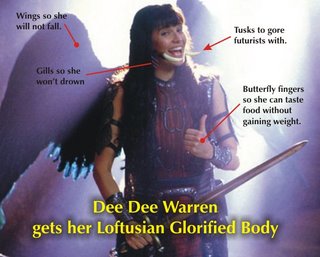
Anyway, my main point here is to just reiterate what the Bible says about rejecting God. Men reject God because they are fallen and at enmity with Him by nature, not because it is truly reasonable (although it may be in the atheists eyes). One such instance is how John Loftus from the "Debunking Christianity" blog argues against God's existence in a rather ridiculous manner. Loftus argues that if God exists, and God is good then we should have wings so we wont fall down. In logical form it would look something like this:

1) Falling hurts people and is bad
2) Wings would remedy this problem
3) If God exists and is good He would have created us with wings so we wont fall.
.:4) Therefore, a good God does not exist

Pretty heavy duty challenge huh? Well the guys at Unchained Radio put up a picture to show what we should look like if a "good" God exists in Loftus' view (with a few other modifications as well):


Well the improvements are undeniable, tusks, butterfly tastebuds on fingers and wings of course. This is total nonesense but Loftus is serious, the point is that this sort of irrational thinking is what happens to the heart that is in rebellion to its maker striving to be autonomous. God is the source of all true knowledge thus to reject Him is to become a fool:

"For the wrath of God is revealed from heaven against all ungodliness and unrighteousness of men, who by their unrighteousness suppress the truth. For what can be known about God is plain to them, because God has shown it to them...For although they knew God, they did not honor him as God or give thanks to him, but they became futile in their thinking, and their foolish hearts were darkened. Claiming to be wise, they became fools." (Rom 1:18-22)


Thursday, August 24, 2006

Exalting in Sola Gratia

Augustine "The nature of the Divine goodness is not only to open to those who knock. but also to cause them to knock and ask."-(Augustine)

Probably the most strongly contested point of the five solas of the Reformation among its protestant heirs is the doctrine of sola gratia, grace alone. We are saved by faith alone through grace alone for the glory of God alone is the phrase. Although more attention will be given to justification by faith in future the question is raised: "If we are saved by trusting (having faith) in the finished work of Christ does that not make our faith what really saves us?" To use the imagery Augustine employs in the above quote the question can be stated: "If we are not saved unless we knock on the door is not our choosing to knock what has saved us?" But as Augustine says not only does God in His goodness open to those who knock but it is His goodness that draws men so they will knock. Thus, salvation from beginning to end is wholly due to the grace of God alone.

Man's Fallen State:

To understand this better we need to have a decent handle on what the bible says about the effects of the Adams fall on mankind. We see early on after the fall that man has become altogether detestable to God, "The thoughts and intents of man's heart was only evil continuously" (Gen 6:5) These new heart affections were not in the original man and woman God had created and this statement in Genesis 6 comes before God sends the flood to punish man. We see the state of man's heart again in Jeremiah 17:9 "The heart is deceitful above all things, and desperately wicked; who can understand it?" The state of man's heart is not a state of neutral indifference it is in a state predisposed think evil and be deceitful. So how does having this fallen state effect man?

In short it effects everything, man's reasoning (Rom 1:21), man's desires (Col 3:5) and the controversial one, the fall has effected man's will. Man's will is a lackey to the desires of the heart and always chooses what the heart most desires, which we have seen is corrupt. Thus, we see statements like:

"as it is written: "None is righteous, no, not one; no one understands; no one seeks for God.
All have turned aside; together they have become worthless; no one does good, not even one."
(Rom 3:10-12)

"Because the carnal [natural] mind is enmity against God: for it is not subject, to the law of God, neither indeed can be." (Rom 8:7)

"The natural person does not accept the things of the Spirit of God, for they are folly to him, and he is not able to understand them because they are spiritually discerned. " (1 Cor 2:14)

In these passages (and many others) it is clear that man in his natural state is at enmity against God, does not accept the things of the Spirit of God, and does not seek God. Now people might seek a "god" but the scriptures teach that there is none that seeks after God. The natural man can be very religious, yet it will be on his terms. The god of the natural man will be treated like ice cream where we pick and choose what kind of god we get, "I'll take the golden rule, and omnibenevolence with a side order of reincarnation please." says the natural man. This is because we naturally find the notion of the true God of the bible offensive, due to the impact of the fall ruining our tastebuds so to speak. It is so bad that Romans 8:7 says man is naturally an enemy of God. So when the natural man hears the message of the cross the bible says it is "foolishness" to him, thus it will be rejected. If this is the case how on earth does anybody come to a saving faith?

Grace Which Leads to Delight:

Man in his ruined state desires not the things of God, but rather the empty promises of sin. This really is the evil of all sin, men turn to sin's hollow promises seeking satisfaction, yet it is God alone that can satisfy our longings, thus all sin is against God. So how then does one with a heart that loves sin and is at enmity with God come to a reconciling faith in Christ? Many will say well we need to exercise our free will and choose to come to Jesus. This however overlooks the scripture's teachings on man's ruined state. Man has no desire to be reconciled to God, so will not choose Christ. Rather, we see that God has promised change our hearts to cause us to desire Him:

"And I will give them one heart, and a new spirit I will put within them. I will remove the heart of stone from their flesh and give them a heart of flesh, that they may walk in my statutes and keep my rules and obey them. And they shall be my people, and I will be their God." (Ezek 11:19-20)

God says that He will act on man's sinful heart and basically give a heart transplant, He will remove the heart of stone and give a heart of flesh that they may walk uprightly. Christ spoke of this as the new birth, Jesus said that unless we are born again we can not enter the Kingdom of God (Jn 3).

question: "How does this new birth come about?"

Most today in rejection of sola gratia will state that we choose to be born again, and many evangelistic tracts have that as one of the "steps to get saved". However being born again is a thing of the Spirit which Paul said the natural man finds foolish, so how can the natural man choose to get born again? "Free will!" is the outcry "We are born again after we choose to place our faith.....really?:

"But to all who did receive him, who believed in his name, he gave the right to become children of God, who were born, not of blood nor of the will of the flesh nor of the will of man, but of God." (John 1:12-13)

"Everyone who believes that Jesus is the Christ has been born of God, and everyone who loves the Father loves whoever has been born of him." (1 John 5:1)

Being born of God in John 1 clearly is due to God not any form of human will, it's a gift, a sheer gift from God. In 1 John we see belief in Christ is preceded by being born of God. The words "has been" in the Greek are in a past perfect tense indicating that the being born of God precedes the believing In Christ and loving the Father. Being born again precedes faith because as we have seen the natural man wants nothing to do with God and is quite happy with his idols and sinful pursuits. Being born again acts as a change of taste buds, where Christ and Christianity once seemed boring and stupid now Christ is altogether lovely and John Newton, Amazing Grace Hymn writerdesireable. Thus, our faith is in itself a gift of God and faith because it is birthed from the unmerited grace of God is in no way the agent that saves. We are saved by grace and grace alone.

This is the amazing grace that takes the hardest of hearts and turns them into hearts of praise. Men like John Newton who was a lecherous slave trader by God's sovereign grace were transferred from the kingdom of darkness to the kingdom of light. Newton gave up the slave trade and labored for the abolishment of slavery in England. Newton of course penned the hymn "Amazing Grace". The grace I have been describing is what that hymn is about, man being in a ruined God rejecting sin loving state and God out of inexpressible love reaches down into the stony heart and opens the spiritual eyes of the sinner so we can sing "I once was blind but now I see!"

We don't see because we wised up and made a decision taking the proper "steps to get saved", no, we see because God gave us eyes to see and thus we came weeping in repentance and joy to Christ the Saving One. To have it the other way around logically is meritorious, I heard one man supporting the I choose to be born again view crisply state "We choose to save ourselves."

On a side note in reference to my discussions with Emergent Christians, I think the truth that we come to faith by God's sovereign grace alone is reason enough for me of why we do not need to change the gospel's presentation to the spirit of the age. Yes, the gospel presentation is stupid and offensive to Postmoderns but not so much because we are postmodern but because the natural man is at enmity with God! We really think that if we doctor the message up that people will get saved due to our slick marketing and craftiness. Nonsense, salvation comes as a gift of God, He opens sinners eyes postmodern or not.

Sola Gratia puts all glory for man's salvation where it belongs to God alone. God out of grace chose to not destroy mankind but sent His Son to save. God was not oblidged to do any saving at all! Yet out of His boundless grace He has chosen to save. Christ truly is the author and finisher of our faith, for our very faith is a gift! Thus, there can be no boasting on the part of the saint who realizes that it is grace alone that makes him a saint.

"Christian! the only thing that makes you differ from the vilest being that pollutes the earth, or from the darkest fiend that gnaws his chains in hell, is the free grace of God!" - Octavious Winslow

Sunday, August 20, 2006

Spurgeon's Insight to Present Day Matters

Each week Phil Johnson at the Pyromaniacs blog puts up an excerpt from C.H Spurgeon that speaks with amazing relevance to present day matters. Considering the talk of emergent conversations and even the new perspective I found last weeks post to be very insightful.

The PyroManiacs devote space at the beginning of each week to highlights from The Spurgeon Archive.The following excerpt is from "Progressive Theology," an article appearing in the April 1888 issue of The Sword and the Trowel. The article echoes some of the Spurgeon material we have posted before, where Spurgeon seems to speak directly to the postmodern spirit.In fact, we've pointed out such comments from Spurgeon many times. We think they offer convincing proof that "evangelical postmodernism" is really little more than Victorian-style modernism decked out in tattoos and punk clothing. See especially here and here. (Phil Johnson)

"Do men really believe that there is a gospel for each century? Or a religion for each fifty years? Will there be in heaven saints saved according to a score sorts of gospel? Will these agree together to sing the same song? And what will the song be? Saved on different footings, and believing different doctrines, will they enjoy eternal concord, or will heaven itself be only a new arena for disputation between varieties of faiths?

We shall, on the supposition of an ever-developing theology, owe a great deal to the wisdom of men. God may provide the marble; but it is man who will carve the statue. It will no longer be true that God has hidden these things from the wise and prudent, and revealed them unto babes; but the babes will be lost in hopeless bewilderment, and carnal wisdom will have fine times for glorying.

Scientific men will be the true prophets of our Israel, even though they deny Israel's God; and instead of the Holy Spirit guiding the humble in heart, we shall see the enthronement of "the spirit of the age," whatever that may mean. "The world by wisdom knew not God," so says the apostle of the ages past; but the contrary is to be our experience nowadays.

New editions of the gospel are to be excogitated by the wisdom of men, and we are to follow in the wake of "thoughtful preachers," whose thoughts are not as God's thoughts. Verily this is the deification of man! . . .It is thought to be mere bigotry to protest against the mad spirit which is now loose among us. Pan-indifferentism is rising like the tide; who can hinder it? We are all to be as one, even though we agree in next to nothing. It is a breach of brotherly love to denounce error.

Hail, holy charity! Black is white; and white is black. The false is true; the true is false; the true and the false are one. Let us join hands, and never again mention those barbarous, old-fashioned doctrines about which we are sure to differ. Let the good and sound men for liberty's sake shield their "advanced brethren"; or, at least, gently blame them in a tone which means approval.

After all, there is no difference, except in the point of view from which we look at things: it is all in the eye, or, as the vulgar say, "it is all my eye"! In order to maintain an open union, let us fight as for dear life against any form of sound words, since it might restrain our liberty to deny the doctrines of the Word of God!But what if earnest protests accomplish nothing, because of the invincible resolve of the infatuated to abide in fellowship with the inventors of false doctrine?Well, we shall at least have done our duty. We are not responsible for success. If the plague cannot be stayed, we can at least die in the attempt to remove it.

Every voice that is lifted up against Anythingarianism is at least a little hindrance to its universal prevalence. It may be that in some one instance a true witness is strengthened by our word, or a waverer is kept from falling; and this is no mean reward.It is true that our testimony may be held up to contempt; and may, indeed, in itself be feeble enough to be open to ridicule; but yet the Lord, by the weak things of the world, has overcome the mighty in former times, and he will do so again.

We cannot despair for the church or for the truth, while the Lord lives and reigns; but, assuredly, the conflict to which the faithful are now summoned is not less arduous than that in which the Reformers were engaged. So much of subtlety is mixed up with the whole business, that the sword seems to fall upon a sack of wool, or to miss its mark. However, plain truth will cut its way in the end, and policy will ring its own death-knell.

-CH Spurgeon