Saturday, April 29, 2006

Why Theology is Important


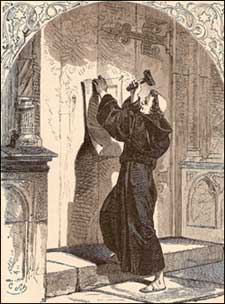
Almost 500 years ago Martin Luther nailed his 95 Theses to the church door in Wittenberg Germany. Luther's theses was a doctrinal challenge to the Roman Churches practice of selling indulgences (selling a pardon for sin). Luther did not intend to start a Reformation however, after questioning the practice of indulgences he found much more of the Catholic churches' practice and theology to be off base with scripture. Later Luther found himself before the emperor Charles the V being asked to recant of his beliefs under penalty of death, Luther before the diet of Worms said "My conscience is captive to the word of God, [...] I will not and cannot recant. Here I stand, God help me." For Luther and the Reformers (and the protestants to come) theology and doctrine were important enough to die for, because the gospel message was at stake.

In contrast, ours is a time where the ideals of humanism and pragmatic relativism are the dominant philosophies. If these are the major streams of thought in our culture it can be expected that these ideas will influence evangelicalism. Thus, pragmatism is very much vibrant today in church practices. The mentality follows thus: "Who cares about theology and analyzing the bible just tell me how to live (12 steps preferably) and make me feel good about myself." Thus pastors in modern emergent churches are taught to feed congregations with a steady dose of humor and quirky anecdotes, web pages are devoted to supplying pastors with jokes for Sunday service, with the aims of making people feel good.

The problem arises however when (if) the joking pastor turns to theological exposition. The people will turn him off thinking "Boring, I want to hear more about your fishing trip thank you very much." Or from the more pragmatic end one may think "Oh enough of this junk about justification just tell me how to keep a healthy marriage." I just want to say that these sort of attitudes are worldly, and are not to be catered to via books or topical sermon series as is the case. Now, of course desiring a healthy marriage is not necessarily a worldly attitude, but seeking a formula to accomplish that goal is standard pragmatism. Unfortunately, the very answers we seek to genuine problems we may have are not found in popular 12 step (Christian or non) books, but in the doctrines of the bible. But the question still flutters about the church "Is theology really important?"

I) Theology is Important Because the Bible is Important

Statements like: "For our sake he made him to be sin who knew no sin, so that in him we might become the righteousness of God. " (2 Cor 5:21) and "For the law of the Spirit of life has set you free in Christ Jesus from the law of sin and death." (Rom 8:2) are loaded with doctrine. One to even understand what is being said in 2 Cor 5:21 needs to know what "sin" is, to learn what "sin" is is to do theology. The theological concept of the "double imputation" is here also. Never mind the jargon what that means is that Christ takes our sin (imputed to Him) and takes the due penalty of it and He clothes us with His righteousness (imputes it to us) thus we have the reward of living a perfect life. My point is that every time we read the bible we are in the process of doing theology.

a) "I'm just not a theology kind of person"

The objection is often raised by Christians saying "I'm not really 'wired' to be a theology person, not my thing." Not my thing...Well I think if our "thing" is going to be living a holy life and treasuring Christ theology must be our "thing". Now I am not saying everyone needs to read beefy Systematic Theologies by dead white guys, what I am saying is that if we care about truth, if we care about holiness, if we care about glorifying God in our lives, theology is out of necessity going to be a part of that. Thus all Christians are theology people, as I pointed out above just to read and try to make sense out of the bible is to do theology, what on earth does it mean to be free from the "Law of sin and death."? What law is Paul talking about here? Mosaic or sinful nature? These are theological issues, and to be a student of God's word is to deal with these issues.

b) "I just don't think theology is really important"

This objection is raised often as well. I think in light of what was said above this is easily dismissed. To say theology isn't important is to say what the bible has to say isn't important. To say baptism, predestination, and the return of Christ aren't real important is to say that God inspired men to write words that are not important, because the bible deals with these issues.

c) "Doctrine divides!"

The popular Schliermacher phrase that "doctrine divides" is tossed around to shut down any theological discourse. It is a true statement but not necessarily bad. The doctrines Luther recovered divided the church, however, I say for the better. Justification by faith alone is a make or break doctrine (that we are saved by faith alone in what Christ did on the cross, nothing else), if you don't believe it I think it's really hard to be called a Christian. This is opposed to the bad doctrine of the Catholic Church at the time where eternal life was basically for sale, and salvation was by faith and works (penance). So yes doctrine does divide, it divides truth from error.

II) Theology/doctrine is practical

For our pragmatist friends I have no 12 steps, I do suggest one, be a student of the word. God truly has supplied us with all we need for life and godliness. In my own life I have found the theological truths to be so very practical. For instance:

a) Justification by faith alone

The sad thing is I really didn't understand justification by faith alone until I was a Christian for over 3 years. Of course I believed I was saved by faith but I always had to try and put up a "good Christian" image for others and defend myself when criticized. Upon realizing that I was justified by faith alone and my righteousness was not my own I found myself freed to be who I really was, a sinner. Now, don't jump to conclusions, what I mean by that is that I was free to be wrong, free to admit mistake, free to confess before others my sin all because at rock bottom my righteousness is in Christ alone.

b) So you want marriage applications?

This truth (justification by faith alone) and the doctrine depravity of man has been my best marriage counselor. When a quarrel may arise I realize it's ok to not defend myself. I can honestly step back and think "Ok how an I sinning here..." Now when Lisa and I get into spats they generally end with us both confessing sin and apologizing to each other. Rather than being a drawn out stalemate with each of us waiting for the other to flinch like two western gunslingers, we are free to admit our wrongs, this is because of the truths that we are sinful, and that our righteousness is not our own. The doctrine of justification by faith alone has without question been the most practical tool in my marriage, not any psychologized advice about boundaries, or being a "self esteem" builder. These are just law which I will fail to keep, but to have the freedom to admit wrong is the greatest help I have gotten in my marriage, and it came from the bible's teaching on justification. (Rom 4:5)

III) Theological Redwoods/ Closing Thoughts

I have really skimmed the surface here with the importance of theology, but I think it is clear that if we are going to care about what the bible has to say we will care about theology. Again I want to reaffirm I am not saying that everybody needs to be like me and read Systematic Theologies in their spare time, but I am saying that we are not to be cavalier in our thinking about theology. I don't think it would hurt to read the Puritans though :) ! When I read the Puritans a difference in quality is distinctly noticeable in comparison to what passes for Christian literature today. The Puritans were theological Redwood trees, they became such by immersing themselves in the bible. Today we have theological cattails giving quick fix answers to people by and large in therapeutic psychologized terms. We can be redwoods, not necessarily by reading dead white guys but by loving the bible and basking in its truth.

In the bible alone do we have the message that people in Uganda need to hear, even if it may cost our very lives. For, in the bible are the words of eternal life, through faith in Jesus Christ alone. God has inspired a book about Himself, man, and the way to eternal life are we not to give our all to understanding His words? Are not the words of Christ: "love the Lord your God [...] with all your mind." (Matt 22:37) fulfilled by a hearty life long devotion to studying his word?

Monday, April 24, 2006

Augustine On The Problem of Evil


I haven't had much time to write on my own blog lately because I have been having a pretty interesting discussion with a Pagan and Emergent Church guys on a different blog. One of the issues of course that almost always comes up when discussing christiany and the bible with non-Christians and Atheists is the "problem of evil". Almost every debate I have listened to b/w a Christian and Atheist the Atheist tried to bring up the problem of evil, asking where did it come from? If God is all good and omnipotent then where did evil come from? Most answers are kind of slapstick appeals to free will, but don't really go in depth in the matter. What follow is from Stand to Reason's page as Gregg Koukl addresses the issue via Augustine. (I am not sure I completely agree but it is a decent answer I think).
Augustine on Evil
Gregory Koukl

Is God the author of evil or its helpless victim? St. Augustine's answer has been the most intellectually credible and emotionally satisfying solution to this vexing problem.
One doesn't need a Ph.D. in theology to look around the world and realize something is desperately wrong. The existence of evil is one of the most vexing challenges a Christian--or any person, for that matter-- must grapple with. It's occupied the minds of great Christian thinkers since the beginning, including St. Augustine (354-430). For much of his life he worked hard at a solution.

Augustine's approach was not just brilliant; it was practical. His insight is intellectually credible and emotionally satisfying in that it gives hope and offers meaning to the Christian trying to make sense out of life in a fallen world.

Two Aspects of the Problem
The problem of evil can be phrased in several ways. One approach addresses the origin of evil, prompting the syllogism (a series of statements that form a reasoned argument): 1) God created all things; 2) evil is a thing; 3) therefore, God created evil. If the first two premises are true, the conclusion is inescapable.
This formulation, if sustained, is devastating for Christianity. God would not be good if He knowingly created evil.

Augustine realized that the solution was tied to the question: What is evil? The argument above depends on the idea that evil is a thing (note the second premise). But what if evil is not a "thing" in that sense? Then evil did not need creating. If so, our search for the source of evil will take us in a another direction

Augustine approached the problem from a different angle. He asked: Do we have any convincing evidence that a good God exists? If independent evidence leads us to conclude that God exists and is good, then He would be incapable of creating evil. Something else, then, must be its source.

If Augustine's approach is fair, it prompts a pair of syllogisms that lead to a different conclusion. First: 1) All things that God created are good; 2) evil is not good; 3) therefore, evil was not created by God. Second: 1) God created every thing; 2) God did not create evil; 3) therefore, evil is not a thing.

The key to success here, is the truthfulness of two premises. If Augustine can offer evidence through natural theology that God exists as Creator and also that God is good, making everything He created also good, then the conclusion--evil is not a thing--automatically follows.
This is Augustine's strategy. If evil is not a thing, then the case against Christianity stated in the original syllogism is unsound because one of its premises is false. The critical question is: What is evil?

Digging a Hole in Goodness
Central to Augustine's idea of goodness (and, consequently, evil) was the notion of being. To Augustine, anything that had being was good. God as the ground of being was perfectly good, along with everything he brought into being. This goodness was a property that came in varying degrees.

With this foundation Augustine was now prepared to answer the key issue: "Where is evil then, and whence, and how crept it in hither? What is its root, and what its seed? Or hath it no being?"[i] To this Augustine answered: "Evil has no positive nature; but the loss of good has received the name 'evil.'"[ii]

Augustine observed that evil always injures, and such injury is a deprivation of good. If there were no deprivation, there would be no injury. Since all things were made with goodness, evil must be the privation of goodness: "All which is corrupted is deprived of good."[iii]
The diminution of the property of goodness is what's called evil. Good has substantial being; evil does not. It is like a moral hole, a nothingness that results when goodness is removed. Just as a shadow is no more than a "hole" in light, evil is a hole in goodness.

To say that something is evil, then, is a shorthand way of saying it either lacks goodness, or is a lower order of goodness than what ought to have been. But the question remains: "Whence and how crept it in hither?"

Augustine observed that evil could not be chosen because there is no evil thing to choose. One can only turn away from the good, that is from a greater good to a lesser good (in Augustine's hierarchy) since all things are good. "For when the will abandons what is above itself, and turns to what is lower, it becomes evil--not because that is evil to which it turns, but because the turning itself is wicked."[iv]

Evil, then, is the act itself of choosing the lesser good. To Augustine the source of evil is in the free will of persons: "And I strained to perceive what I now heard, that free-will was the cause of our doing ill."[v] Evil was a "perversion of the will, turned aside from...God" to lesser things.[vi]

Flawed Perfection
Augustine's solution has not been satisfying to some. Friedrich Schleiermacher snorted at the concept that God gave good creatures the freedom to do bad. If a being is perfect in its goodness, he held, it would never sin even if it were free to. Evil would then have to create itself ex nihilo, which is ridiculous.[vii]

However, it doesn't follow that moral perfection necessarily entails immutability. That's a different type of perfection, a perfection in being. Schleiermacher's objection confuses the two. The fact that a perfectly beautiful vase is capable of being broken doesn't take away from its aesthetic perfections. In the same way, it makes sense to say that man was created morally perfect (morally whole or complete, at his proper level of goodness), even though he wasn't immutable in this perfection.

The objections raised by atheist philosophers J.L. Mackie and Antony Flew are more substantial.[viii] Isn't it possible that God could have created man immutable in his goodness, yet still have the opportunity to freely choose in other areas? Won't man have immutable goodness in heaven? And will he not also have freedom to choose among certain options? Why not here on earth? Couldn't God construct man's nature such that evil simply was not an option?
Mackie and Flew are right in one regard. God could have created such a world. Freedom in the larger sense (the ability to make choices) does not require freedom in the narrow sense (the ability to make moral choices).

They miss the big picture, though: God would not have accomplished a second purpose. He not only wanted free creatures; He also wanted plenitude, that is, the greatest good possible. Plenitude--the highest good, the best of all possible worlds--requires more than just general freedom; it requires moral freedom, and that necessarily entails the possibility of evil.
Since all that God made is good, even those things which appear evil only appear that way because of a limited context or perspective. When viewed as a whole, that which appears to be evil ultimately contributes to the greater good.

For example, certain virtues couldn't exist without evil: courage, mercy, forgiveness, patience, the giving of comfort, heroism, perseverance, faithfulness, self-control, long-suffering, submission and obedience, to name a few. These are not virtues in the abstract, but elements of character that can only be had by moral souls. Just as evil is a result of acts of will, so is virtue. Acts of moral choice accomplish both.

The Best of All Worlds
A world that had never been touched by evil would be a good place, but it wouldn't be the best place possible. The best of all worlds would be a place where evil facilitated the development of virtues that are only able to exist where evil flourishes for a time. This would produce a world populated by souls that were refined by overcoming evil with good. The evil is momentary. The good that results is eternal.

What good comes out of a drive-by killing, someone might ask, or the death of a teenager through overdose, or a daughter's rape, or child abuse? The answer is that a commensurate good doesn't always come out of those individual situations, though God is certainly capable of redeeming any tragedy. Rather, the greater good results from having a world in which there is moral freedom, and moral freedom makes moral tragedies like these possible.

A Heavenly Twist
This observation reveals an interesting twist in this problem. If morality freely chosen can only happen in a world where evil is possible, then heaven will be a place where there will be no moral growth, where moral choices will not be possible because all the inhabitants of heaven will be immutably good. There is a type of soulish growth only available to inhabitants of a fallen world.

Two Scriptural observations lend credibility to this view. First, in recounting the great heroes of faith, the writer of Hebrews mentions that some were rescued by faith, but others endured by faith "...in order that they might obtain a better resurrection."[ix] (Heb. 11:35) Second, Paul tells Timothy that "...godliness is profitable for all things, since it holds promise for the present life and also for the life to come." (1 Tim. 4:8)

Both of these verses indicate that conditions in this life effect conditions in the next. Bearing up under evil in this life improves our resurrection in the next. Godliness in this life brings profit in the next. These benefits are not available after this life or there would be little urgency to grow now; all eternity would be left in which to catch up.
It appears that a deeper, more profound good results when virtue is won by free, moral souls struggling with evil, rather than simply granted to them as an element of their constitution.

Spoiled Goodness
Augustine knew that evil was real. Independent evidence (natural theology) was enough to convince him that God existed and that everything He created would be good. Evil, then, must be something real, but not a "thing" in the conventional sense. Evil is not a created thing, but spoiled goodness made possible by the free moral agency of rational creatures. Evil is not something present, but something missing, a privation.

The challenge that God could have created a world of free-will creatures immutable in their goodness is answered by the notion of plenitude, the greatest good. The possibility of evil also makes a greater good possible. God made a world in which true moral decision-making and development of virtues is possible in humans, manifest by persons whose character is formed through growth and struggle.

There's a sound reason why God has allowed evil. It doesn't conflict with His goodness. God is neither the author of evil, nor its helpless victim. Rather, precisely because of His goodness He chooses to co-exist with evil for a time.

[i] Augustine, Confessions, VII: [V] 7.
[ii] Augustine, The City of God, XI, CHAP. 9.
[iii] Augustine, Confessions, VII: [XII] 18.
[iv] Augustine, City of God, XII, CHAP. 6.
[v] Augustine, Confessions VII: [III] 5.
[vi] Ibid., [XVI] 22.
[vii] Encyclopedia of Philosophy, Vol. 3, 138.
[viii] See J.L. Mackie, "God and Omnipotence," Mind, April 1955, and Antony Flew, "Divine Omnipotence and Human Freedom," New Essays in Philosophical Theology, 1955 (referenced in Encyclopedia of Philosophy, Vol. 3, 138).
[ix] Scripture quotations are from the New American Standard Bible.

Sunday, April 16, 2006

Christ Is Risen! (The Peace He Leaves)

.

"I am the resurrection and the life. Whoever believes in me, though he die, yet shall he live,
and everyone who lives and believes in me shall never die. Do you believe this
?" (John 11:25-26)

"For if we have been united with him in a death like his, we shall certainly be united with him in a resurrection like his. " (Rom 6:5)

"Blessed be the God and Father of our Lord Jesus Christ! According to his great mercy, he has caused us to be born again to a living hope through the resurrection of Jesus Christ from the dead," (1 Pet 1:3)

It's resurrection day, the day where Christians celebrate Christ's resurrection from the dead, thus finalizing the redemption of His church. Christ did not merely say He was dying for our sins, and ask us to trust Him. He validated His trustworthiness through conquering death, thus all who are united with Him share in the blessed rewards of His labors. On Good Friday Lisa and I read a sermon by Jonathan Edwards on the passage "Peace I leave with you; my peace I give to you. Not as the world gives do I give to you." (John 14:27) In Edwards' sermon he describes the peace which Christ promised to leave as a sort of will, a will to into effect upon His death (see Heb 9:17). Many different aspects of the peace can be noted, but the one I want to hit upon is death.

Death troubles all men for all men, for all men will die. Edwards notes that the only peace that an unconverted sinner can have surrounding death and God is to suppress the thought of them. Don't think seriously about your mortality and definitely don't give any serious thought to standing before God, suppress these thoughts (via tv, music, sex, idle chatter etc). This is in contrast to the believer who is in union with Christ. For the believer Christ has died for him, He has suffered wrath in his place. Thus the fear of death has lost its sting, and he may approach the throne of God boldly in the righteousness of Christ. The believer is free to think of death, for "Death where is thy sting" (Rom 8) and "To die is Gain" (Phil 1:21). Thus the believer can look upon these in the light and have peace where the unbeliever must remain in darkness to maintain a sort of peace.

The peace of the unbeliever says Edwards is like "The ease and pleasure that a drunkard may have in a house on fire over his head." This is a miserable state of self delusion. One may think of the avenues of securing peace that men pursue such as obtaining riches. It is immensly grievous when we see TV preachers calling people to Jesus in the name of securing a worldly estate, for they prey right on mans desire of peace, offering them a placebo (riches) when the sole antidote lies in the death and resurrection of Christ. These call men to as Christ described "build bigger barns" so that they may take rest (Lk 12:18-20), this is foolishness Christ says, for they ignore the weighty matter of peace, namely peace with God.

So, in Christ the believer has a firm foundation. Death has lost its sting and indeed is a blessing. Whereas the worldling is left to only suppress thoughts and deceive himself that all is well creating a false peace which will inevitably be overthrown.

The last aspect of the peace which Christ has left His people I want to look at is their being satisfied in Him. The worldling is left to seek joy in that which does not ultimately satisfy:

"Why do you spend your money for that which is not bread, and your labor for that which does not satisfy? Listen diligently to me, and eat what is good, and delight yourselves in rich food."
(Isa 55:2)

This is definatly where I agree with Anselm and his view on sin as being a blow to the honor of God. For sin says that God is not satisfying and to be desired thus I will turn elsewhere this is great evil. For that which men abandon is infinitely satisfying, whereas what they turn to is at best a temporal joy. As Jeremiah writes:

"for my people have committed two evils: they have forsaken me, the fountain of living waters, and hewed out cisterns for themselves, broken cisterns that can hold no water." (Jer 2:13)

But the believer knows where the fount of joy is, as Christ promised "He who drinks of the water that I shall give Him will never thirst..." (John 4) This fountain of satisfaction is both now and not yet. It transcends death in its promise of blessing, thus again to die is gain. Here is a joy that can not be taken away irregardless of circumstance come death or imprisonment. This indeed is great peace which Christ has left us. For as it is promised that those who partake in His death will share in His resurrection. Christ has completed in full the redemption of His church, thus she can have great peace for the Lord is risen, securing her salvation and eternal joy.

"When you pass through the waters, I will be with you; and through the rivers, they shall not overwhelm you; when you walk through fire you shall not be burned, and the flame shall not consume you." (Isa 43:2)


(Sunrise on the Red River from "Nature Images" from photographer Paul Brown)

Thursday, April 13, 2006

Whatever Happened To: Preaching the Cross?

It's Passover and with Good Friday and the crucifixion of Christ on the minds of millions worldwide, I just ask whatever happened to preaching the cross? I don't wont to go on a big assessment of evangelicalisms failings here rather my main goal is to celebrate the most significant event in the history of the world, the crucifixion of Jesus Christ. However, the sad but true fact is that many of our churches are going to skip right over a serious contemplation of what the cross of Christ really means. Why? For a number of reasons, all which seem to be rooted in this one biblical verse:

"But if I, brothers, still preach circumcision, why am I still being persecuted? In that case the offense of the cross has been removed." (Gal 5:11)

What Paul refers to as he refers to "still preach circumcision" is a system of justification by works. Interestingly he says if I teach circumcision why am I being persecuted? Aside from the obvious that he would be right in step with the Judaizers, I think persecution would be eliminated because the natural man can manage law. Just tell me what to do. Believe in Jesus and do x, y, and z and you will be right with God, if that is what Paul taught like the Judaizers then " In that case the offense of the cross has been removed." Why? Because it is Jesus and me cooperating for my salvation, something I can manage, the natural man loves this stuff. Why else are millions upon millions of dollars spent on 12 step books by Christian and non-Christian authors (saying the same stuff just a different language game)? How do you grow a church today? Give people (x) days or (y) steps to purpose or "Find the Champion" in them, or how to get your best life now, and they flock.

Ultimately Luther classified such theology as a "theology of glory". The natural man is very pleased to embrace a theology of glory, one that gives him specific steps and promises success if followed thus the person has grounds for glorying in themselves in a sense. This is precisely what the church growth movement thrives upon, giving people what they want, a spirituality that they can manage themselves. The offense is removed.

Why would Paul call the cross an offense? Because it destroys all theologies of glory, Jewish, Muslim, Buddhist, Catholic, Theraputic evangelicalism, etc. The cross says that not the labors of our hands but the death of a substitute ALONE is what reconciles men to God. The cross says that no one will do enough "good" and tip the scales in their favor, but says to man "This was done in your place." One can see what this implies about our righteousness...it is "filthy rags"

"We have all become like one who is unclean, and all our righteous deeds are like a polluted garment. We all fade like a leaf, and our iniquities, like the wind, take us away." (Isa 64:6)

Yikes! That's not exactly the "Find the champion in you" message that we naturally are inclined to embrace. However, it is passages like this that give the cross its meaning. "Mine mine was the transgression, but Thine the deadly pain." We are transgressors, and deserving of Gods wrath yet "He has made Him who knew no sin to be sin for us that we might become the righteousness of God in Him." (2 Cor 5:21) The offense surfaces the cross makes a blow at our righteousness (glory) putting the natural man to death, but in doing so it raises us to life in Christ who gives us His own perfect righteousness as a free gift. Thus God alone gets the glory, this Luther called this "the theology of the cross", in opposition to the theology of glory.

Thus we come as beggars to God with Christ and His cross as our plea for mercy, again this is opposed to a Theology glory for no one wants to be a welfare case. I find people get really edgy when I start talking about us being beggars before God. I don't know how many times people had to burst in saying "But we need to remember were God's children" implying that we aren't beggars. Well there's truth to that, and I don't want to minimize adoption, however that follows as a benefit of coming as a beggar through trust in Christ and having the blessing of the cross applied.

"But to all who did receive him, who believed in his name, he gave the right to become children of God, who were born, not of blood nor of the will of the flesh nor of the will of man, but of God."(John 1:12-13)

This is the essence of the gospel, this is Christianity: That through faith alone in the sacrifice of Christ in our place on the cross we are made right with God. The glory of Christ is manifested in the cross: He who judges the universe humbled Himself to be judged falsely by men. He who alone is infinitely exalted, sunk lower than any other man has or will by bearing our guilt. He who is infinitely good and perfect, became the most sinful man ever to exist. He who alone did not deserve God's wrath suffered greater wrath than anyone. It's really humbling to know that that is what is saving our souls from hell.

Monday, April 03, 2006

The Consequences of Ideas


As I was listening to a Christian talk radio show today called "Crosstalk", which was discussing homosexuality, a caller called in to express his upset feelings toward the hosts. What the man said was not that he disagreed with them that homosexuality was wrong per se but rather that he thought it was arrogant for the hosts to talk as though they "had the truth". He repeatedly said he was not religious but thought that everyone is on their own "path to truth" and basically that it is just plain wrong to say that another's' view of truth was invalid. The hosts began responded to the man gracefully but it seemed to me that they missed the heart of what was wrong with what the man had said (although what the hosts had to say was indeed right on). I began stammering to the radio "No! Address the relativism!". The host did a fair job in responding, the problem is that I highly doubt that the caller saw the flaw of his reasoning. Rather, by having bible verses quoted to refute him he no doubt only saw more confirmation of an intolerant arrogant narrow-minded Christian view, which claims to have the corner on the truth market. The man needed to see the fundamental flaw of his reasoning, namely that it was relativistic and self defeating.

What was wrong with what the caller said was that his statements, and all relativistic statements for that matter, is that by their very nature they are self refuting. Take for example the statement "It is arrogant for you to claim that you have the truth." What is being said here? One is saying that it is wrong for you to say that anothers views are wrong and yours are right thus claiming monopoly on truth. That's interesting, so you are telling me that it is wrong for me to think that others' views are wrong? When someone says that they are doing the very thing they claim we are not to do, namely telling you that what you think is wrong. Not to mention the fact that by even making such a statement one is making a truth claim. The truth claim of the above statement is that all truth claims are equally valid. Is that the truth? The truth we need to adhere to when dealing with truth claims? It is a self refuting argument on multiple fronts.

The same goes for almost every pop-spiritual slogan in our day. It's an excellent rule of thumb when analyzing a statement to see if it meets its own claimed standard. I have been snacking on Greg Koukl and Francis Beckwith's book "Relativism: Feet Firmly Planted In Mid-Air" (cover above) it has very good reasoning and helps one see the hollowness of so many of the cultural slogans about "tolerance","morals", "judgment" and "truth". It is a powerful book and shows the consequence of ideas, which we can see right in our own day. Greg (This brought tears to my eyes as I read it) cites a testimony of a nurse in a hospital who was called by another nurse saying "come see mrs X's baby" she was led into the nurses lounge where to her horror she saw a premature baby still breathing lying on a steel examination table while the nurses sat smoking cigarettes and drinking coffee on break. Upon asking what was going on she was told that the baby was too premature to bother attempting to save. The child was 19 weeks old in seven more days he would have qualified. The nurse held the child saying "He's still alive..." Only to have the head nurse snatch the baby and stuff him in a formaldehyde jar. He was just trash at nineteen weeks old. (p.21-22)

That's pretty rough to hear, and it may seem a far cry from "it's arrogant to claim to have the truth" but I don't think the two are separable. Although the caller on the show probably wouldn't support such a horrific treatment of a child yet by his very position he really can't say that such behavior is wrong, for that would be to make an absolute truth claim. In such a world-view what is horrific to one is normal to another and neither person can be definitively right and wrong. In such a world-view one can adamantly support saving the whales while supporting eugenics through aborting postborn babies with down syndrome. In essence men within the context of a relativistic world view have completely lost any moral compass. These are the consequences of bad ideas.

Relativism is the philosophical result of man starting from himself in a multi-religious society, as the arbiter of truth, thus resulting in a "to each his own" religious and moral mileau. God has made Himself known in His word we are not left to treat Him as ice cream and pick and choose what kind of God we will worship. We are to worship the Lord "In spirit and in truth" (John 4). God has revealed His moral standard to us throughout the bible and shown us what is right living and what is wrong living.

And ultimately God has revealed His plan of salvation to man in Christ, and Christ alone. Christ made claims as no other, He is not one among the many flavors we can choose from all leading to the same place. Christ claimed that He is the way, the only way for man to escape the wrath of almighty God, (we in American culture really don't fear God as we should, we see Him as a philanthropist...That's a different post). Christ and Christ alone is the hope for man to be saved, no one else made such a claim, not Buddha not Muhammad, not Bahaualalu, only Christ claimed to die for the sins of the world. I'll let the Word speak for itself:

"Truly, truly, I say to you, unless you eat the flesh of the Son of Man and drink his blood, you have no life in you. Whoever feeds on my flesh and drinks my blood has eternal life, and I will raise him up on the last day. For my flesh is true food, and my blood is true drink. Whoever feeds on my flesh and drinks my blood abides in me, and I in him. As the living Father sent me, and I live because of the Father, so whoever feeds on me, he also will live because of me. This is the bread that came down from heaven, not as the fathers ate and died. Whoever feeds on this bread will live forever." (John 6:53-58)

That is either true or it is false.

Friday, March 31, 2006

Raising Children in a Christian home, child abuse?


According to atheist evolutionist scientist Richard Dawkins yes. The following is an article from worldnet daily talking about Dawkins show "The Root of All Evil" (religion):

Controversial scientist and evolutionist Richard Dawkins, dubbed "Darwin's Rottweiler," calls religion a "virus" and faith-based education "child abuse" in a two-part series he wrote and appears in that begins airing on the UK's Channel 4, beginning tomorrow evening.
Entitled "Root of All Evil?," the series features the atheist Dawkins visiting Lourdes, France, Colorado Springs, Colo., the al-Aqsa mosque in Jerusalem and a British religious school, using each of the venues to argue religion subverts reason.

In "The God Delusion," the first film in the series, Dawkins targets Catholicism at the pilgrimage site in Lourdes. "If you want to experience the medieval rituals of faith, the candle light, the incense, music, important-sounding dead languages, nobody does it better than the Catholics," he says.
Dawkins, using his visit to Colorado Springs' New Life Church, criticizes conservative U.S. evangelicals and warns his audience of the influence of "Christian fascism" and "an American Taliban."

The backdrop of the al-Aqsa mosque and an American-born Jew turned fundamentalist Muslim who tells Dawkins to prepare for the Islamic world empire – and who clashes with him after saying he hates atheists – rounds out the first program's case for the delusions of the faithful.
In part two, "The Virus of Faith," Dawkins attacks the teaching of religion to children, calling it child abuse.

"Innocent children are being saddled with demonstrable falsehoods," he says. "It's time to question the abuse of childhood innocence with superstitious ideas of hellfire and damnation. Isn't it weird the way we automatically label a tiny child with its parents' religion?"
"Sectarian religious schools," Dawkins asserts, have been "deeply damaging" to generations of children.
Dawkins, who makes no effort to disguise his atheism and contempt for religion, focuses on the Bible, too.

"The God of the Old Testament has got to be the most unpleasant character in all fiction: jealous, and proud of it, petty, vindictive, unjust, unforgiving, racist," he says. Dawkins then criticizes Abraham, compares Moses to Hitler and Saddam Hussein, and calls the New Testament "St Paul's nasty, sado-masochistic doctrine of atonement for original sin."
John Deighan, a spokesman for the Catholic Church, took issue with Dawkin's denunciation of religion, telling the Glasgow Sunday Herald, "Dawkins is well known for his vitriolic attacks on faith, and I think faith has withstood his attacks. He really is going beyond his abilities as a scientist when he starts to venture into the field of philosophy and theology. He is the guy with demonstrable problems."

Madeline Bunting, a columnist for the Guardian, who reviewed the series, wrote: "There's an aggrieved frustration that [atheist humanists] have been short-changed by history – we were supposed to be all atheist rationalists by now. Secularization was supposed to be an inextricable part of progress. Even more grating, what secularization there has been is accompanied by the growth of weird irrationalities from crystals to ley lines. As G.K. Chesterton pointed out, the problem when people don't believe in God is not that they believe nothing, it is that they believe anything."

Dawkins, perhaps best known for his much-cited comment that evolution "made it possible to be an intellectually satisfied atheist," appeals to John Lennon in a commentary he authored for the Belfast Telegraph on the eve of his program's premiere: "Religion may not be the root of all evil, but it is a serious contender. Even so it could be justified, if only its claims were true. But they are undermined by science and reason. Imagine a world where nobody is intimidated against following reason, wherever it leads. "You may say I'm a dreamer. But I'm not the only one."
(End Article)

My Reply:

The problem with Dawkins statements about what is morally right and wrong for people to do is that any moral statement he may make is wholly arbitrary. One can equally be justified and say that to raise one's children in an atheist evolutionist home is child abuse. My point is that these are just statements, but are based upon nothing at all except Dawkins' fancy. Dawkins' show "The Root of All Evil" labels religion (all of it) as one of the greatest contributor to social disorder in history. Dawkins cites the Protestant/Catholic controversy in Ireland, Muslim suicide bombers, and of course the crusades to show that religion is the root of evil. Well I firstly would ask where does Dawkins get his standard of what is right and wrong? Who's to say that suicide bombing isn't actually "good"? I don't think Dawkins or any atheist really has an answer for where they get their standard of what actions are morally right and which are wrong.

The only response to the above question I have heard atheists make is "That which harms the happiness of people is wrong." Only problem is that this statement too is arbitrary. Some people derive happiness from harming others so to tell them they can not harm others is to deny them their happiness. This is what morality is reduced to when we remove God from the picture, just arbitrary statements with no real truth value just the whimsical dogmas of some "expert elite".

I still find it odd that Dawkins is a biologist yet he seems to speak more on religion than upon his area of biology, it seems to me that darwinism is Dawkins religion and he is fighting the competitors. In response to level the plain I would say bad ideas is the root of all evil. Take evolution at the turn of the 20th century, because of this theory Australian aborigines were planned to be eugenically bred out for their own good. If a mixed child would be found he/she would be taken from their parents and put in a boarding school with the hope that they would eventually procreate with a caucasion thus over time get the bad aborigine traits eliminated from society. This is one example of what bad thinking around evolution can do I can cite more like the pygmy who was taken from Africa and put in a cage next to a chimpanzee with the label over his cage "The missing link". The point is that if you are going to throw muk at religion for bad things that happened in the name of God and proudly boast of your atheist evolutionary view you need to look at the skeletons in your own closet.

Ultimately in the Bible we as Christians have a standard of right and wrong, a standard which says the crusades were wrong for example. The bible gives answers to the question "How should we then live?" where a non theistic view leaves man to arbitrarily decide what is right and wrong.

Tuesday, March 28, 2006

"Weak Verificationism" and Evolution

Before I move on from the topic of evolution and science I had intended to mention one other method of justification of theories in science that is fallacious. Now for the most part in the previous posts I have been talking philosophically against evolution rather than going through every scrap of evidence for and against the theory of evolution. To do the latter would require a blog of its own, thus I have focused on the philosophic side. To analyze what are the criteria that distinguishes science from non science is the work of philosophers not scientists. This is the area of philosophy known as the philosophy of science. For example to answer questions like: "Should science be done objectively?" and "What makes a theory acceptable?" are questions philosophers deal with answering because such questions are kin to ethical and epistemological questions. Thus the scientific method is not based upon science but rather philosophy. This is why in the last post I dealt with a few of the typical logical fallacies (Ad pop, and ad hom) used to defend evolution theory. I want to here address some ways in which theories (particularly evolution) are justified that are just plain bad...sucka.

I) Weak Verification:

A popular way in which non-scientific theories pass as scientific is "Weak verification". By verification I mean a person lays out theory "A" and says:
1) If theory "A" is true then we should see hypotheses"B",
2) We find "B" therefore
3) Theory "A" is very probably true

Now this may seem as though it is a sensible way to go about things and indeed it is logical. Many theories' hypotheses are tested using such methods. A problem arises when there is no way in which hypotheses "B" can not be found to be true this I call "weak verification". Take for example Freudian psychology, Karl Popper writes:

"The Freudian analysts emphasized that their theories were constantly verified by their "clinical observations." As for Adler, I was much impressed by a personal experience. Once, in 1919, 1 reported to him a case which to me did not seem particularly Adlerian, but which he found no difficulty in analyzing in terms of his theory of inferiority feelings, although he had not even seen the child. Slightly shocked, I asked him how he could be so sure. "Because of my thousandfold experience," he replied; whereupon I could not help saying: "And with this newcase, I suppose, your experience has become thousand-and-one-fold."What I had in mind was that his previous observations may not have been much sounder than this new one; that each in its turn had been interpreted in the light of"previous experience," and at the same time counted as additional confirmation. What, I asked myself, did it confirm? No more than that a case could be interpreted in the light of the theory. "

What Popper is getting at is that no matter the circumstances Freud and Adler have an psychologized explanation of the person being examined that fits perfectly into the theory thus "confirming" the theory. To put it in my own words take psychologized egoism, there is no behaviour that does not fit into the theory. What about helping an old lady cross the road? The theorist can answer "Actually that is egocentric too, look at the helper's motives possibly good feelings from helping, or atention from on lookers." Do we see what is happening? The theory has an explanation for every behavior making the behavior square perfectly with the theory.

It is my contention that much of the same sort of "weak verification" is employed to prop up evolution theory, at least in part. I cite for example the common ancestry theses of evolution. This states that all of life came from the same source, and given time, mutation, and natural selection has produced the wide array we now see (Dogs, whales, cats, chimps, alligators, flowers, bumble bees, trees, and humans). All of the things I listed share a common ancestor according to this theses. Evidence given for example is the striking similarities between human and Chimpanzee DNA over 98% identical. Thus we have strong evidence for common ancestry theses.

I disagree, for the same reasons Popper rejects the Freudian egoism theses. I think that if Chimp/human DNA were 90% alike this would be used to support common ancestry as would 75%. When a theses is accepted it is easy to go about and point to things that allegedly verify its truthfulness. The problem with the 98% identical DNA being supportive of common ancestry is that it is subjectively interpreted data. One could equally look at it and say "Wow God used similar blueprints in His creation." Also a good rule of thumb is to remember that statistics are misleading. 98% identical sounds radically close. If someone said my brother and I looked 98% identical you would think that they meant apart from a mole or two we looked identical, and this would make sense. However, when you are talking about DNA 2% difference is huge, thus the percent needs to be weighed relatively to what it is describing.


(This is the difference 2% DNA separation makes, a world of difference!)


II) Some Final thoughts

Before I move on from evolution I just want to make clear that I in these last 3 posts have NOT proven evolution to be false, I have merely exposed some bad arguments used to justify and defend evolution. Ultimately we need to look at the evidence and consider what it points to. I for one have not been too impressed by drawings of half ape men in caves with clubs who are supposedly links between human and apes. I would be impressed if they found some fossil remains, not only of humans and ape links, but multiple other species and their ancestors. Not only that how about some intermediaries when the first arms were slowly being developed over time? There really should be plenty of this stuff if evolution is indeed an accurate description of origins, yet there seems to be a lack of its discovery. To be fair I think there are problems with the Intelligent Design arguments like I said in the last post, namely it is basically a "god of the gaps" argument. Many have picked up on this and asked why does "god" have to be the intelligent designer why not the "Flying Spaghetti Monster"? (there is an actual FSM page) I think this criticism is correct. That is why I personally don't think ID is the way to go. There is no "god of the gaps" problem when you begin with God and His word. Rather, I think evolution is a gap filler for a philosophy without God as the starting point.

When we begin with God and His revealed truth we enjoy a freedom the naturalist does not enjoy. This brings me back to my point of methodological naturalism which I think drives much of the rhetoric of "science vs religion" in our day. To restate the issue, methodological naturalism says the only right answers you can have in the scientific endeavor are naturalistic ones, to quote Alvin Plantinga on this:
"Judgements here, of course, may differ widely between believer in God and non-believers in God. What for the former is at best a methodological restriction is for the latter the sober metaphysical truth: her naturalism is not merely provisional and methodological, but, as she sees it, settled and fundamental. But believers in God see the matter differently. The believer in God, unlike her naturalistic counterpart, is free to look at the evidence for the Grand Evolutionary Scheme and follows it where it leads, revising that scheme if the evidence is insufficient. She has a freedom not available to the naturalist. The latter accepts the Grand Evolutionary Scheme because from a naturalistic point of view this scheme is the only visible answer to the question what is the explanation of the presence of all these marvelously multifarious forms of life? The Christian, on the other hand, knows that creation is the Lord's; and she isn't blinkered by a priori dogmas as to how the Lord must have accomplished it. Perhaps it was by broadly evolutionary means, but then again perhaps not. At the moment, 'perhaps not' seems the better answer."

Plantinga's point is that the Atheist is bound to a naturalistic explanation of the origins of life, where as it is not necessarily the case for the believer. The believer can be open to a theistic evolution view as well as a special creation view of life's origins, the believer is the one who is truly free when it comes to this issue.

That being said I find it highly unlikely that life's' origins are explained by evolution theory based upon what evidence I do know of. Again I think evolution represents an ideology that is anti-christian, again I know it doesn't have to be (theistic evo) however, it is indeed used as a God supplanter in philosophy. Again I refer to Augustine's description of a battle between the City of God and the City of the world, and say I stand against evolution not because it necescarily undermines Gods existance per se, but men are going to hell believing evolution is accurate and there is no God to whom they will give an account. Men's eternal souls are at stake here.